Microtunnelling vs. Pipe Jacking: What Is the Difference?
Microtunnelling and pipe jacking are closely related, but they do not describe exactly the same thing.
Pipe jacking is the pipe-installation principle. Microtunnelling is a remotely operated, guided and controlled tunnelling system that normally uses pipe jacking to advance the machine and install the pipeline.
According to widely accepted industry terminology, microtunnelling is a remotely controlled and guided pipe-jacking operation that provides continuous support to the excavation face. Routine personnel access to the excavation face is generally not required.
Pipe jacking: the installation method
Pipe jacking is a trenchless construction method in which specially designed pipes are pushed through the ground from a launch shaft toward a reception shaft.
Hydraulic jacks installed in the launch shaft apply thrust to the pipe string. This thrust is transferred through the jacking pipes to the shield or tunnelling machine at the excavation face.
The basic sequence is:
- The shield or tunnelling machine excavates the ground.
- Excavated material is removed from the face.
- Hydraulic jacks advance the machine and pipe string.
- A new jacking pipe is lowered into the launch shaft.
- The jacking cycle is repeated until the reception shaft is reached.
The installed jacking pipes normally perform several functions simultaneously:
- Transmit the jacking force.
- Support the surrounding ground.
- Form the permanent pipeline or tunnel lining.
- Provide a watertight jointed system.
- Carry the final hydraulic or utility load.
Pipe jacking does not define one specific excavation system. Excavation may be:
- Manual or semi-mechanised in suitable man-entry conditions.
- Performed by an open-face shield.
- Mechanically excavated using a backacter, roadheader or rotating cutterhead.
- Undertaken using a closed-face slurry or earth-pressure-controlled machine.
- Remotely controlled or personnel-operated, depending on the system and diameter.
Spoil may be transported by slurry pipelines, augers, conveyors, skips, rail-mounted muck cars, vacuum systems or other suitable arrangements.
Microtunnelling: the controlled excavation system
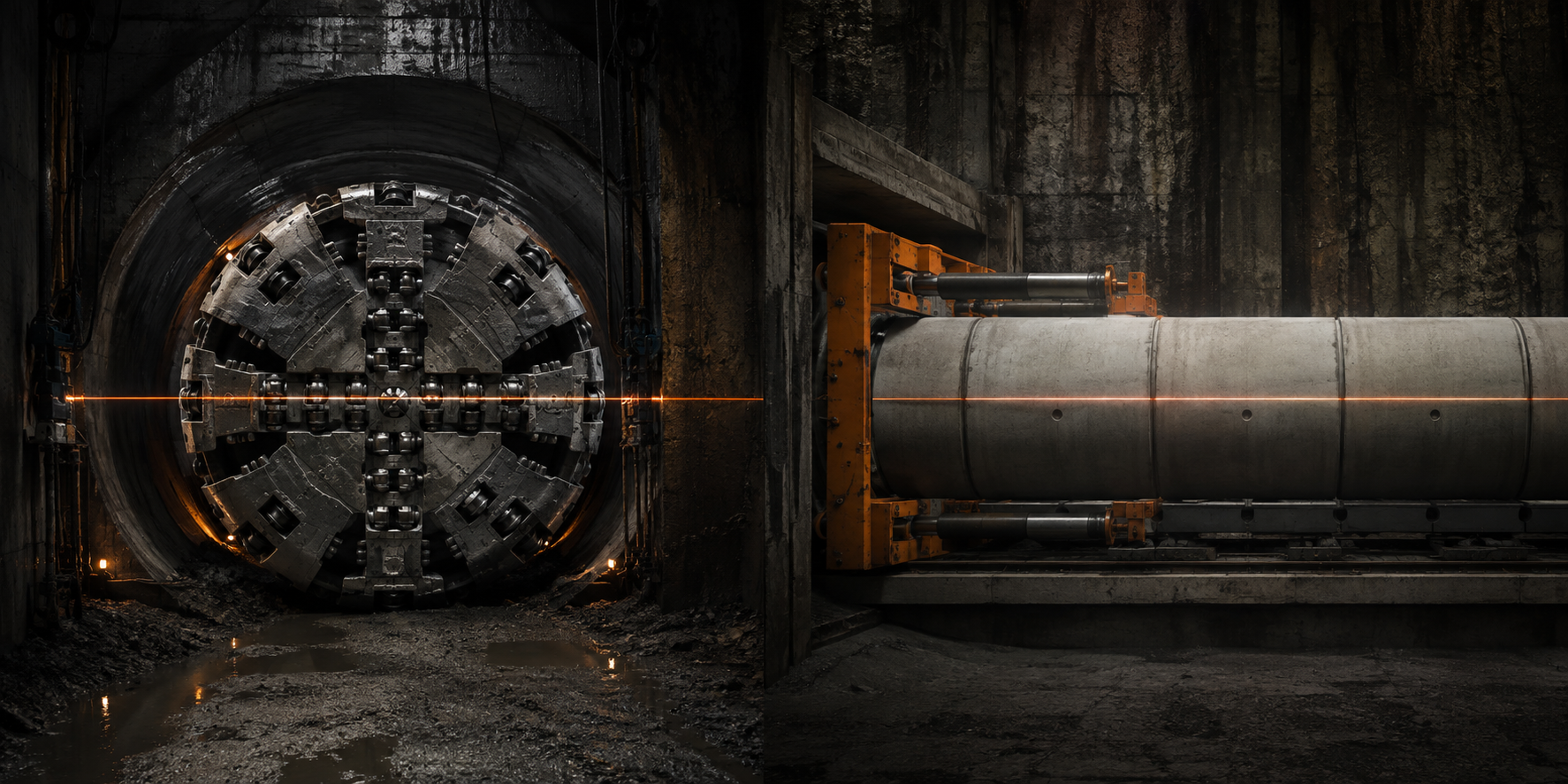
Microtunnelling is a specialised form of mechanised pipe jacking using a Microtunnel Boring Machine, or MTBM.
The MTBM is normally operated from a control cabin at the surface. It is not usually self-propelled. The main jacking station pushes the jacking pipes, and the pipe string transfers the thrust to the machine.
The defining characteristics normally include:
- Remote operation from outside the tunnel.
- Continuous monitoring and guidance.
- Active steering capability.
- Controlled mechanical excavation.
- Continuous or controlled support of the excavation face.
- Simultaneous installation of jacking pipes.
- No requirement for routine personnel access to the excavation face.
The operator typically monitors and controls:
- Horizontal and vertical alignment.
- Machine position, pitch, roll and steering direction.
- Excavation rate.
- Cutterhead speed and torque.
- Main jacking force.
- Individual steering-cylinder positions and pressures.
- Face-support pressure.
- Slurry feed and return pressure, where applicable.
- Slurry flow rate and density.
- Excavated volume or spoil balance.
- Lubrication pressure and injection quantity.
- Intermediate Jacking Station operation.
- Settlement-related operating parameters.
Guidance may be provided by laser-based systems, electronic targets, hydrostatic water-level systems, gyroscopic navigation or a combination of technologies. The selected system depends on drive length, diameter, gradient, curvature, shaft configuration and required tolerance.
Face support and spoil transportation
Slurry microtunnelling is widely used, particularly below groundwater and in unstable or mixed ground. However, microtunnelling should not automatically be defined as slurry excavation.
Depending on the machine and ground conditions, microtunnelling systems may use:
- Slurry pressure.
- Earth pressure or conditioned excavated material.
- Mechanical face-support arrangements.
- Auger-based spoil removal in suitable ground.
- Specialised rock or mixed-ground excavation systems.
In a slurry MTBM, pressurised slurry supports the excavation face and transports the excavated material through the slurry return line to a separation plant. The separation plant removes soil, sand and gravel before the slurry is conditioned and recirculated.
Face pressure must be controlled within a suitable operating range:
- Insufficient pressure may cause ground loss, face instability, groundwater inflow and settlement.
- Excessive pressure may cause ground heave, slurry loss, hydrofracture or surface breakout.
Face-pressure control is therefore one of the most important aspects of microtunnelling, especially in water-bearing sand, soft ground and beneath sensitive structures.
Guidance and steering
An MTBM normally changes direction through articulated steering cylinders located between sections of the machine.
The guidance system identifies the machine’s position relative to the design alignment. Steering corrections are then applied gradually while excavation and jacking continue.
Accurate guidance does not mean the machine can make unlimited corrections. Steering capability is restricted by:
- Machine articulation limits.
- Pipe-joint angular capacity.
- Minimum permitted curve radius.
- Ground reaction around the machine.
- Overcut and annular-gap geometry.
- Pipe length and diameter.
- Jacking-force distribution.
- Allowable line and level tolerances.
Excessive or late steering corrections can increase jacking forces, damage pipe joints, enlarge the excavation envelope and increase settlement risk.
Jacking forces and lubrication
Both conventional pipe jacking and microtunnelling rely on axial jacking force. The required force is primarily influenced by:
- Friction between the pipe string and surrounding ground.
- Machine face resistance.
- Pipe diameter and drive length.
- Ground type and groundwater conditions.
- Overcut and annular gap.
- Alignment and curve radius.
- Pipe-joint deflection.
- Lubrication quality and continuity.
- Machine stoppages and ground consolidation around the pipes.
Bentonite-based lubrication is normally injected into the annular space around the pipe string to reduce skin friction. It is not the same as the slurry used for face support and spoil transportation, although both systems may contain bentonite.
For long drives, Intermediate Jacking Stations—IJS or interjacks—may be installed within the pipe string. They divide the total drive into shorter jacking sections, reducing the force that must be transferred through the entire pipe string.
Is diameter the defining difference?
No. Diameter alone does not determine whether an operation is microtunnelling.
Historically, the term “microtunnelling” was often associated with non-man-entry diameters, while larger drives were described as pipe jacking or mechanised tunnelling. However, modern remotely operated MTBMs can work at large diameters.
Therefore:
- A small diameter does not automatically make a drive microtunnelling.
- A large diameter does not automatically prevent it from being microtunnelling.
- Whether personnel can physically enter the pipe is not, by itself, the deciding factor.
The more technically reliable distinction is based on remote operation, guidance, steering, mechanised excavation and controlled face support, rather than a fixed diameter threshold. Terminology can nevertheless vary between countries, authorities and project specifications.
When is microtunnelling preferred?
Microtunnelling is generally preferred when a project requires:
- High line-and-level accuracy.
- Installation below groundwater.
- Controlled excavation in unstable ground.
- Low risk of settlement.
- Minimal surface disruption.
- Construction beneath roads, railways, buildings or utilities.
- Installation of gravity pipelines with strict gradient tolerances.
- Remote excavation without routine personnel at the face.
- Reliable monitoring and recording of operating parameters.
Typical applications include:
- Gravity sewers.
- Stormwater pipelines.
- Water transmission pipelines.
- Utility crossings.
- Road and railway crossings.
- Airport infrastructure.
- Sea outfalls and intake pipelines.
- Industrial pipelines and service ducts.
Important limitations and design considerations
Microtunnelling is not automatically the best solution for every crossing. Its suitability depends on:
- Ground and rock conditions.
- Groundwater pressure.
- Boulder or obstruction risk.
- Mixed-face conditions.
- Required diameter and pipe material.
- Drive length and alignment.
- Minimum curve radius.
- Available launch and reception shafts.
- Jacking-pipe capacity.
- Main jacking-station capacity.
- IJS requirements.
- Separation-plant capacity.
- Slurry-pump and pipeline capacity.
- Lubrication design.
- Settlement criteria.
- Surface access and logistics.
- Machine recovery and intervention strategy.
A successful system must be designed as one integrated operation. Selecting only the MTBM diameter is not sufficient; the machine, cutterhead, crushing system, slurry circuit, separation plant, guidance system, jacking pipes, joints, lubrication arrangement, shafts and jacking equipment must all be compatible.
The practical distinction
The clearest technical distinction is:
| Pipe jacking | Microtunnelling |
|---|---|
| Describes how pipes are installed and advanced | Describes a specialised remotely controlled tunnelling system |
| Hydraulic jacks push the pipe string | Normally uses the same pipe-jacking principle |
| Excavation may be manual, mechanical or remote | Excavation is mechanised and remotely controlled |
| Guidance and face-pressure control vary by system | Continuous guidance and controlled face support are defining features |
| Personnel entry may be required in some systems | Routine personnel access to the excavation face is generally unnecessary |
| Spoil transport may use skips, conveyors, augers or slurry | Slurry is common, but it is not the only possible arrangement |
Final definition
Pipe jacking is a trenchless installation method in which pipes are hydraulically pushed through the ground behind an excavating shield or tunnelling machine.
Microtunnelling is a remotely operated, guided and steerable form of mechanised pipe jacking that provides controlled excavation and continuous support to the tunnel face, generally without requiring routine personnel access to the face.
Therefore, in the conventional MTBM arrangement:
Microtunnelling uses the pipe-jacking principle, but not every pipe-jacking operation meets the technical definition of microtunnelling.
This distinction is consistent with the definitions used by the International Society for Trenchless Technology, the Pipe Jacking Association and FHWA microtunnelling specifications.