
History of NDRC and Microtunnelling in Dubai
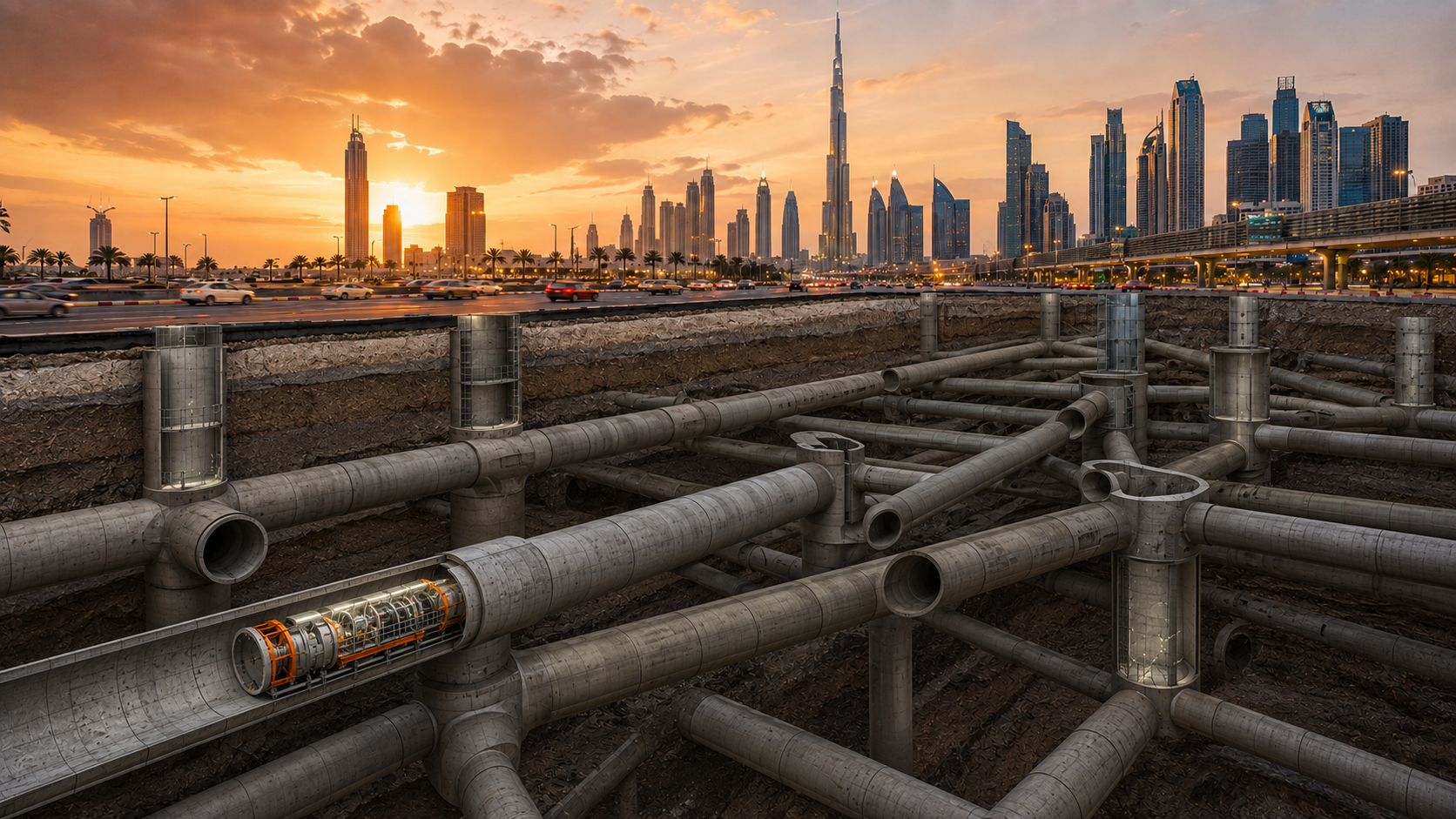
Dubai's rise as a global city is usually described through what can be seen above ground. An equally important transformation has taken place below the surface. Sewerage, stormwater, utility and transport corridors have progressively moved underground, while construction methods have evolved from conventional excavation toward controlled trenchless systems.
This article traces the documented development of non-disruptive road-crossing works and microtunnelling in Dubai. It distinguishes verified historical evidence from unsupported claims and shows how a specialist crossing technique became one of the enabling technologies of modern urban infrastructure.
1. What NDRC means in Dubai
In Dubai, NDRC commonly describes non-disruptive road-crossing works: underground utility construction carried out without conventional open-cut excavation across roads or other sensitive surface corridors. The Roads and Transport Authority lists NDRC as a distinct category within its NOC process.
Dubai Supply Authority uses a broader trenchless classification and identifies pipe jacking, thrust boring and microtunnelling among the commonly used methods. Microtunnelling is a remotely controlled, guided and slurry-supported method suited to work below the groundwater table. NDRC is therefore an application framework, not one machine type; microtunnelling is one of its principal delivery technologies.
2. Why trenchless construction became necessary
Dubai's modern sewer infrastructure dates back to the 1960s. By the early 1990s, ageing buried assets beneath a rapidly developing city created a difficult engineering problem: networks needed rehabilitation while commercial activity, government functions and transportation continued above them.
Later urban development intensified the constraint. Wider highways, denser districts, airports, rail infrastructure, utility corridors and high groundwater increased the operational impact of open excavation. NDRC evolved as a practical response to the city's geometry: the surface became too valuable and too busy to disrupt whenever a buried service crossed it.
3. 1994: the earliest strong published record identified
The most important early source identified is Upgrading Dubai's Sewers, published by the American Society of Civil Engineers in August 1994. It records microtunnelling, pipe bursting and pipe eating within a rehabilitation programme covering more than 29,000 m of pipe, planned to avoid disruption to major commercial, government and transportation activity.
The defensible historical conclusion is that microtunnelling was demonstrably in active use in Dubai by August 1994.
The accessible evidence does not prove that this was Dubai's first-ever NDRC or microtunnelling contract. A credible technical history must separate the earliest verified record from the actual first use.
4. 2002: infrastructure governance becomes more formalised
Dubai's Local Order No. 8 of 2002 assigned the competent Dubai Municipality department responsibility for planning, designing and constructing public sewerage networks, treatment plants and rainwater drainage networks. Although not a microtunnelling specification, it marked the increasingly formal governance structure behind progressively larger underground projects.
That control environment developed into today's multi-agency NOC framework, in which NDRC is a defined works category and trenchless crossings near critical utility corridors are governed by dedicated technical guidance.
5. Mid-2000s: beneath live airport infrastructure
A technical record for the Dubai International Airport Expansion Project reports more than 4,000 m of surface-water drainage and service tunnels completed with four remote-controlled microtunnelling machines in diameters of approximately 600-2,000 mm.
The works passed beneath live taxiways and aprons, in places with overburden of about 4 m. This showed the value of microtunnelling where settlement control and uninterrupted surface operation were primary requirements.
6. 2013: NDRC beneath major urban roads
The Nad Al Sheba 4 Sewerage & Drainage project provides another historical marker. A stormwater trunk crossed Emirates Road and adjacent service roads in a heavily trafficked corridor reported as six to sixteen lanes. Trenchless construction was selected to avoid traffic disruption.
One section used CC-GRP jacking pipe with an AVN machine at about 8.6 m depth, with groundwater reported at about 3.9 m. The reported Dubai premiere applied to the specific jacking-pipe product, not to microtunnelling itself.
7. 2019: the long-distance microtunnelling era
Dubai International Airport Expansion Phase 3 included three pipe-jacked drives of 610 m, 765 m and 825 m for a stormwater drainage tunnel beneath Terminal 2 taxiways. The approximately 2,200 m system was built at depths of about 13-15 m while airport operations continued.
An 825 m drive requires integrated management of pipe-soil friction, jacking force, lubrication, slurry transport, separation capacity, guidance accuracy, restart forces and intermediate jacking stations. The project demonstrated a mature capability for long-distance trenchless work beneath highly sensitive infrastructure.
8. A defined technical and approval discipline
RTA now identifies NDRC as a separate NOC works category and requires supporting technical submissions including method statements. DUSUP guidance distinguishes open-face pipe jacking from remotely controlled, slurry-supported microtunnelling and notes that intermediate jacking stations may be required on long routes above 200 m, subject to corridor-specific requirements.
A specialist construction technique has therefore become embedded in Dubai's formal design-review, risk-control and utility-protection processes.
9. 2020-2021: strategic deep-tunnel systems
Dubai Municipality's Deep Tunnel Stormwater Project moved the underground strategy beyond individual pipe-jacked crossings. Its 10.3 km tunnelling stage included a final 2.5 km section beneath Sheikh Zayed Road toward Jebel Ali. The main pumping station was designed for 110 m³/s, or approximately 9.5 million m³/day.
The Municipality later described a tunnel of approximately 10 m internal diameter at 40-60 m depth serving a drainage area of about 500 km². A large TBM tunnel is not the same as an NDRC crossing, but it follows the same urban strategy: essential infrastructure moves below ground so the city can continue operating above.
10. 2025-2026: Tasreef and the next scale
Tasreef is a long-term stormwater-development programme estimated at AED 30 billion and planned for completion by 2033. Dubai Municipality states that it will increase network drainage capacity by 700%, to more than 20 million m³/day.
Contracts announced in 2025 and 2026 include more than 36 km of new drainage lines, a main tunnel up to 4 m in diameter and more than 27 km of integrated drainage works. Dubai's strategy has progressed from isolated crossings toward connected tunnel networks, deep shafts, pumping stations and major surface-water systems.
11. Why NDRC became essential to Dubai
- Traffic continuity: strategic roads cannot be repeatedly closed for open-cut crossings.
- Dense utilities: new alignments pass through increasingly congested underground corridors.
- Groundwater: many projects require controlled excavation below the water table.
- Settlement sensitivity: airports, railways, highways and structures impose strict deformation limits.
- Growing capacity: larger sewerage and stormwater systems demand larger, better-controlled systems.
- Longer crossings: urban geometry increasingly requires drives beyond a simple road width.
12. The technical evolution of Dubai microtunnelling
Modern long-distance drives depend on a complete operating system. Machine selection must match geology, groundwater pressure, diameter and intervention strategy. Face pressure and slurry parameters must limit ground loss. Separation capacity must match production, lubrication must continuously manage friction, and predicted jacking forces must be compared with measured forces.
Guidance must remain reliable as distance increases, while intermediate jacking stations must be planned before thrust reaches critical values. Modern NDRC performance depends on the interaction of ground investigation, machine capability, slurry control, jacking mechanics, monitoring, shaft design and logistics.
Conclusion
Dubai's NDRC history is the underground counterpart of its urban growth. Microtunnelling was already being used in 1994 to rehabilitate a congested sewer network. It later moved beneath highways and live airport infrastructure, progressed to several-hundred-metre drives and became embedded in formal approval systems.
Infrastructure can continue to grow below ground while the city above remains operational.
References
- Derr, H.R. & Jones, B.W. (1994), Upgrading Dubai's Sewers, Civil Engineering / ASCE, Vol. 64, No. 8, pp. 60-63.
- Government of Dubai, Local Order No. 8 of 2002.
- UNITRACC, Trenchless Installation of Utility Tunnels - Safe Airport Tunnelling in Dubai, c. 2006.
- HOBAS / Amiblu (2013), CC-GRP Jacking Pipes Premiere in Dubai.
- Herrenknecht AG (2019), Aircraft Take-offs Above, Tunnel Construction Below.
- Dubai Municipality (2020), Deep Tunnel Drainage Project.
- Dubai Municipality (2021), deep tunnel pre-operational stage update.
- Government of Dubai Media Office, Tasreef programme.
- Government of Dubai Media Office (2026), five Tasreef Phase Two contracts.
- Roads & Transport Authority, Dubai, NOC service - Non-disruptive road-crossing works.
- Dubai Supply Authority (2023), Guidelines for Utilities Crossing Hydrocarbon Pipelines, DP-OPSON-0158 Rev 01.
- Dubai Municipality (2025), contracts for four Tasreef project phases.
Source verification note: References were checked against publicly accessible source pages on 24 August 2026. No source identified proves the first-ever NDRC or microtunnelling project in Dubai; the 1994 publication is presented as the earliest strong published record identified.
Oğuzhan Ataşalar
Microtunnelling & NDRC Project Manager · Dubai